
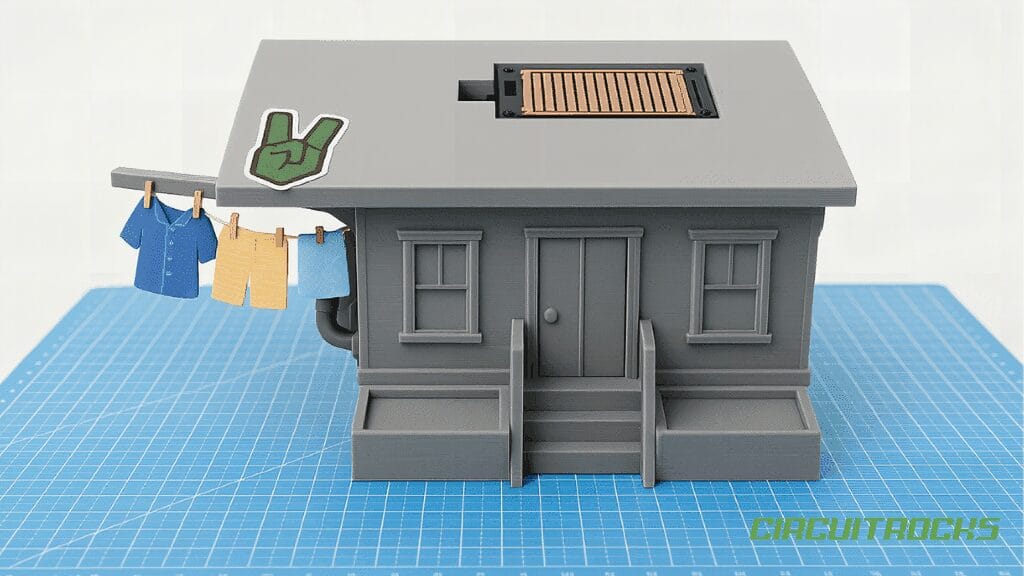
Caught off-guard by sudden rain? Build a Smart Laundry Bot that senses raindrops and automatically pulls your clothesline to safety – no more panic sprints to the backyard. With a rain sensor, a servo motor, and an Arduino Uno, you’ll turn a practical idea into a polished smart-home prototype.
This build focuses on a simple goal: when the first droplets land, the line retracts; when skies clear, it goes back out. The mechanism is compact, reliable, and gentle on your clothes – perfect for balconies or small outdoor spaces.
To make the project presentation-ready, we house the system in a custom 3D-printed miniature home. It’s a great way to combine electronics and design: you’ll wire the automation inside, mount the sensor neatly, and end up with a project that both works and looks good.
What You’ll Learn
By completing the Smart Laundry Bot project, you’ll gain skills in automation and Arduino.
- How to use a rain sensor to trigger automation.
- Practical applications of electronics for everyday chores.
- How servo motors can power moving mechanisms.
Why Build a Smart Laundry Bot?
This isn’t just a clever household hack – it’s a mini automation system that shows how sensors, code, and motion control come together to solve an everyday problem. You’ll practice reading inputs, debouncing weather signals, and commanding a motor with safe limits.
It’s ideal for students and DIYers who want tangible results fast. The project scales well, too: start with a tabletop demo, then adapt the mechanism for longer travel or outdoor mounting. Along the way, you’ll pick up practical design habits – strain relief, weather protection, and tidy wiring inside a custom enclosure
If you’re interested in other servo-based weather projects, you can also check out the 3D Mini Rain Car Wiper. In the same way, it uses a servo motor to mimic real-world automation – this time, replicating the motion of car wipers when it rains.
What You Need
How It Works
The Smart Laundry Bot uses a simple sense → process → react cycle:
- Rain Detection: The rain sensor monitors for water droplets.
- Signal Processing: Once rain is detected, the Arduino processes the signal.
- Automatic Action: The servo motor immediately pulls back the clothesline to safety.
- Clear Weather: When the rain stops, the servo extends the clothesline back to let clothes dry in the sun.
This smart yet straightforward setup mimics the logic behind automated windows, greenhouse covers, and other smart weather systems.
Applications & Extensions
Protect more than laundry. Adapt the same trigger-and-retract idea to guard balcony sun-shades, window louvers, scooter seats, package drop boxes, or outdoor tools. In makerspaces, you can auto-close a 3D-printer enclosure vent or flip a cover over moisture-sensitive materials. In small gardens, add a hinged lid to seed trays to prevent over-watering during sudden showers.
Make it smarter and connected. Upgrade to an ESP8266/ESP32 to push rain alerts via MQTT/Telegram, or log rainfall duration to microSD for a simple weather record. Add DHT22 humidity or a soil-moisture probe to choose between “keep drying” or “pause,” and include AUTO/MANUAL modes with a push button or IR/remote override.
Beef up mechanics and power. For longer travel or heavier loads, switch from a hobby servo to a geared DC motor or linear actuator, and add limit switches for precise end-stops. Print a tensioned spool/roller, route the line cleanly, and seal electronics inside a weatherproof box with cable glands. For outdoor, off-grid installs, use a 12 V battery + buck to 5 V and keep it topped with a small solar panel for all-weather
Watch the Full Demo Video
Here’s the Smart Laundry Bot in action.
.cr-vrow { display: flex; justify-content: center; max-width: 100%; } /* Horizontal video */.cr-vid16x9 { width: 800px; aspect-ratio: 16 / 9; border-radius: 14px; overflow: hidden; background: #000; box-shadow: 0 6px 16px rgba(0,0,0,.15); }.cr-vid16x9 iframe { width: 100%; height: 100%; border: 0; display: block; } /* Mobile view adjustment */ @media (max-width: 768px) {.cr-vid16x9 { width: 100%; max-width: 100%; } }Frequently Asked Questions
What does this Smart Laundry Bot tutorial cover?
Caught off-guard by sudden rain? Build a Smart Laundry Bot that senses raindrops and automatically pulls your clothesline to safety—no more panic sprints to the backyard.
Can I use an Arduino Nano or Mega instead of UNO for the Smart Laundry Bot build?
Yes. Nano shares the same ATmega328P and pinout. Mega has more I/O if you outgrow UNO. The code stays the same — just match the pin numbers used in the Sample Code section.
Why does my Smart Laundry Bot sketch fail to upload?
Usually wrong COM port, missing CH340/CH341 driver for clone boards, or another program holding the serial port. Disconnect the board, install the driver, reselect the port, retry.